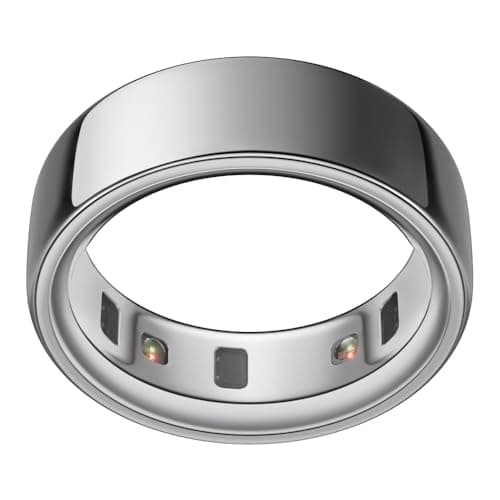
In-depth Oura Ring 4 review UK 2026. Smart Sensing, AI Advisor, 8-day battery, sleep staging accuracy. Is this the best AI smart ring for UK adults?
📊 Review Score Breakdown
Disclosure: This article contains affiliate links. As an Amazon Associate, AIToys.co.uk earns from qualifying purchases. If you buy through our links, we may earn a small commission at no extra cost to you.
Oura Ring 4 Review UK 2026: The AI Smart Ring That Finally Earned Its Place
The Oura Ring 4 is the wearable that most quietly insinuated itself into our daily routine over the last six months. It does not buzz, it does not flash, and it has no screen. It simply sits on your finger collecting data — heart rate, heart rate variability, skin temperature, blood oxygen, movement — and then quietly distils all of that into a morning summary that, more often than not, has been correct.
That is the pitch in a sentence. The longer version is more interesting. The Gen 4 is the most significant Oura hardware refresh in five years, and the on-device AI Advisor that arrived with the 2025 app update — and matured through 2026 — has finally turned a glorified sleep tracker into something closer to a personalised health coach. For UK readers weighing up a Galaxy Ring, a RingConn Gen 2 or a discounted Gen 3, this review is meant to help you decide whether the new flagship is the right one to put on your finger.
We wore the Silver Oura Ring 4 (size 8) daily for just over six months, alongside the Apple Watch Ultra 2 and a RingConn Gen 2 on the opposite hand, sleeping, training, travelling and showering in it. The verdict, after roughly 180 nights of data, is that it is the best overall smart ring you can buy in 2026 — but it is not the right ring for everyone, and the subscription deserves more honesty than it usually gets in reviews.
Key Features at a Glance
Oura's headline upgrade for Gen 4 is what it calls Smart Sensing. The previous Ring Gen 3 used three protruding sensor bumps on the interior of the ring; Oura has replaced those with a flush array of 18 recessed optical pathways (up from eight), allowing the ring to dynamically choose which combination of LEDs and photodiodes gives the cleanest signal for your particular skin tone, finger shape and movement pattern. In practice this means two things: the ring is dramatically more comfortable to sleep in, and the data is steadier — especially during exercise and overnight rolls.
The other major changes are practical. The ring is now fully titanium (the Gen 3 had a polymer interior), the battery has stretched from a quoted seven days to a quoted eight (we averaged five to six in real use), and there are six finishes and twelve sizes (4 through 15) covering most adult fingers. Water resistance is rated to 100m, so showers, swims and saunas are fine — Oura still asks you not to dive with it.
Underneath the metal, the Oura Ring 4 tracks more than 50 biometrics, grouped into six categories on the redesigned Today screen: sleep staging (deep, REM, light and awake), heart health (resting heart rate, HRV, cardiovascular age, VO₂ max, respiratory rate), body temperature deviation, blood oxygen and breathing disturbance index, daily activity (40+ auto-detected sports, steps, calories), and the readiness and stress block that ties it all together into the Readiness Score that long-time Oura users will recognise.
In March 2026 Oura layered two more features on top: the Resilience Metric, which tracks the rolling 14-day balance between stress and recovery, and a new women's health AI model trained specifically on female physiology, which makes the cycle and hormonal insights noticeably more useful than the generic averages of previous versions. The on-device Oura Advisor is the headline AI feature — more on that below.
What We Like
The first and biggest win is comfort. The recessed-sensor redesign is not a minor refinement. The Gen 3 had a habit of leaving three small indentations on the underside of your finger overnight, and there were enough nights where it dug in that we'd occasionally take it off. Six months into the Gen 4 we have not once been aware of it while sleeping, and we've used it as a wedding-ring style fit on the dominant hand without scratching anything on a desk or steering wheel.
The sleep tracking is the second win, and it is the headline reason most people buy an Oura. A 2025 study from researchers at Brigham and Women's Hospital found the Oura Ring (Gen 3 at the time) to be the most accurate consumer sleep tracker for four-stage sleep classification, beating Apple Watch by roughly five per cent and Fitbit by roughly ten per cent when compared against polysomnography. The Gen 4 hardware tightens the signal further. Sleep timing and stage estimates lined up almost exactly with how we felt in the morning, and the ring picked up unusually short or fragmented nights with a precision that the wrist-based trackers we wore alongside it simply did not match.
The AI Advisor is the third, and most pleasantly surprising, win. Before the mid-2025 update it was a generic wellness chatbot, and we did not use it. Since then it has been given proper access to your personal biometric history, and the difference is substantial. You can ask it "Why is my Readiness Score low today?" or "What's driving my HRV trend this week?" and it will draw on your actual sleep, temperature, HRV and activity data to answer. Over time it learns your patterns — "your HRV consistently drops the day after a late dinner", say — and surfaces those insights without being asked. We initially expected it to be a gimmick. It is not.
The other small joys: the morning Today screen is the best home dashboard of any wearable we tested, the Vitals tab is genuinely useful for spotting an oncoming cold (the temperature deviation flagged two illnesses for us before symptoms showed), and the eight-day quoted battery is realistic if you keep continuous SpO₂ off and roughly six days if you leave it on.
What Could Be Better
The £5.99-a-month (or £69.99-a-year) Oura Membership is the thing that's hardest to defend in a review, and we won't pretend otherwise. It includes the first month free with the ring, after which the Readiness Score, sleep stages, the AI Advisor, illness insights, women's health features and most of the deeper analytics sit behind the subscription. You can still see live heart rate, basic sleep totals and activity, but the bits most people bought the ring for are paywalled. Competitors like the RingConn Gen 2 charge nothing for their equivalents, and that is a real and ongoing cost-of-ownership consideration that adds up to roughly £70 every year for the life of the ring.
The second weakness is exercise. Oura is explicit about this — it's an HRV and recovery tracker first, and a workout device a distant second. There is no live workout display (it's a ring, of course), heart rate accuracy during high-intensity cardio lags a chest strap noticeably, and grip-heavy sessions in the gym can leave small scratches on the titanium finish. If your priority is training intensity in real time, you'll still want a watch alongside it — we used it with the Apple Watch Ultra 2 for that exact reason.
The third nit is small but worth flagging. Sizing is not standard ring sizing — Oura uses its own scale, and you do need to order the sizing kit first (£10, credited against the ring purchase) and wear the dummy ring for at least 24 hours before deciding. We had to swap from a size 9 to a size 8 after sizing, and others have gone the other way. Skip this step at your peril; the wrong size means unreliable data and an uncomfortable wear.
Finally, the price. Titanium finishes start at around £349, the new ceramic versions are £499, and the Stealth black PVD coating sits in the middle. Compared with a Fitbit Charge 6 at roughly £140 or a Samsung Galaxy Ring at around £399, the Oura is firmly the premium pick. For the right buyer it is worth it; for a casual sleep-curious user it is overkill.
Who Is It For?
The Oura Ring 4 is the right wearable for adults who are serious about sleep and recovery but do not want a watch on their wrist. That includes shift workers, new parents, frequent travellers managing jet lag, women tracking cycles and hormonal patterns, biohackers, and anyone in a sport like running or cycling who wants to layer recovery data on top of a training watch they already love.
It is also the right pick for people who specifically dislike the visual presence of a smartwatch. The ring looks like a wedding band — and in the Brushed Silver, Gold or Rose Gold finishes it looks like a slightly nicer one than most. It crosses into formalwear and business meetings without comment in a way the Apple Watch Ultra 2 simply cannot.
It is the wrong pick for three groups. First, anyone whose primary use case is live workout tracking — buy a Garmin or an Apple Watch. Second, anyone allergic to recurring subscriptions on principle — the RingConn Gen 2 gives you 90 per cent of the experience for a one-time payment. Third, anyone who only takes one item off at night — the ring needs roughly 20–40 minutes on its charger every five or six days, and if you're not in a routine of charging it during showers or morning coffee, it'll inevitably die mid-sleep at some point.
For everyone else, it sits comfortably alongside our existing recommendations in the best AI smartwatches and fitness trackers UK 2026 roundup as the discreet, sleep-focused alternative.
Value for Money
This is the part of the review where the subscription has to be confronted honestly. Buying an Oura Ring 4 in 2026 means committing to roughly £349 up front and £69.99 a year in ongoing fees. Over three years that's £559 — comparable to a high-end smartwatch with no ongoing cost, and roughly double what a RingConn Gen 2 costs over the same period.
If you'd buy it purely as a step counter, it's expensive. If you'd buy it as a sleep tracker — and the data and feature set you get is unmistakably best-in-class — it earns its keep. The AI Advisor in particular has become the feature we'd miss most if Oura took it away, and that is something we did not expect to write six months ago.
For UK readers specifically, the £349 entry price tracks closely with the official Oura store and is competitive on Amazon. Prices fluctuate; we've seen the Silver size 8 dip to around £321 at Amazon during sales periods. Always check the current price before buying — it'll be one of the largest single-item purchases you make from this site this year.
Final Verdict
The Oura Ring 4 is the most refined smart ring you can buy in the UK in 2026, and the AI Advisor is the first wearable AI feature we've used that genuinely changes day-to-day behaviour. The redesigned interior is a real comfort upgrade, the sleep tracking remains the benchmark the rest of the industry is measured against, and the new resilience and women's health features round it out into something close to a personalised health coach for adults who care about recovery.
It is not perfect. The subscription is the loudest objection, and a real one — over a three-year horizon you'll spend nearly as much again on Oura Membership as you did on the ring itself. The titanium scratches if you grip-train hard, the workout tracking is rudimentary by smartwatch standards, and the sizing process is fiddlier than it should be.
But if you weight your wearable spending towards sleep, recovery, illness early-warning and quiet 24/7 health awareness — and if you'd rather not wear a watch all day — there is nothing else on the market that does it better. We'd take a Gen 4 over a Gen 3, an Apple Watch as a sleep tracker, or any of the budget rings, and we'd take it with the subscription. Recommended, with eyes open.
Rating: 4.6/5 — The best smart ring in the UK, with a subscription caveat.
Related reading
- Our wider roundup of the best smart rings UK 2026 compares the Oura Ring 4 directly against RingConn, Samsung and Ultrahuman.
- For wrist-based alternatives, see the best AI smartwatches and fitness trackers UK 2026.
- If body composition matters more than continuous wear, the Withings Body Smart is the companion bathroom scale we use.