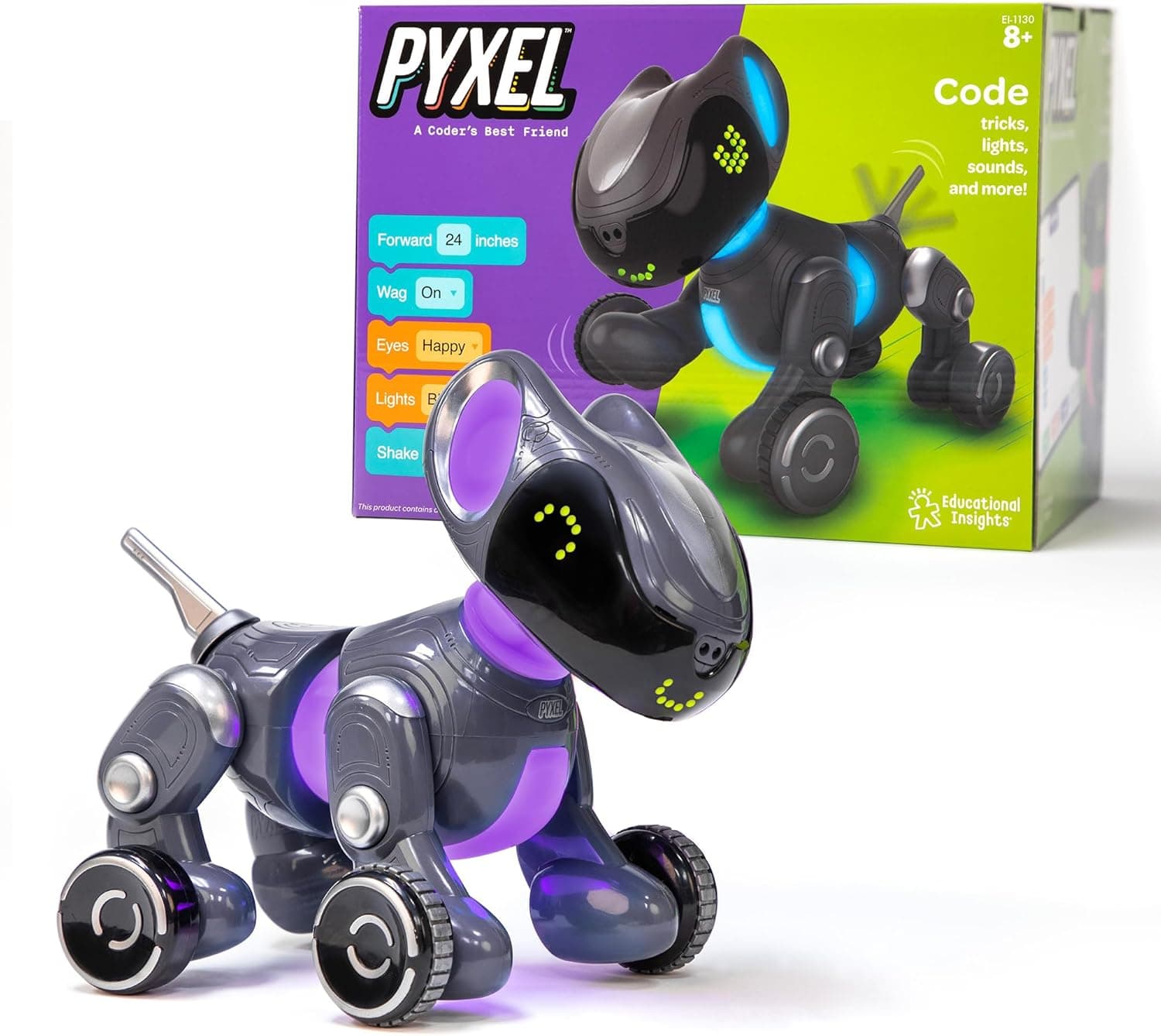
Unlock coding fun with the PYXEL Coding Pet. Our in-depth review for UK parents covers features, pros, cons, and whether this educational robot is worth…
📊 Review Score Breakdown
_This article contains affiliate links. When you make a purchase through links on our site, we may earn an affiliate commission at no extra cost to you._
Learning Resources PYXEL Coding Pet Review UK 2026 — Is It Worth It?
In the ever-evolving world of educational toys, finding something that genuinely engages children while teaching valuable skills can be a challenge. The Learning Resources PYXEL Coding Pet claims to be a child's "best friend" for embarking on a coding journey. But does this interactive robot dog truly deliver on its promise in the UK market? As parents, we’re constantly looking for toys that blend fun with meaningful learning. This in-depth review will explore everything the PYXEL Coding Pet has to offer, from its programming capabilities to its play value, helping you decide if it’s the right investment for your budding coder aged 8 and above.
[

🛒 Check Latest Price on Amazon UK
Quick Verdict
The PYXEL Coding Pet is a fantastic entry point into text-based coding for children aged 8+. Its ability to switch between visual Blockly and text-based Python provides a smooth learning curve, making complex concepts accessible. While its robotic movements are somewhat basic, the interactive elements like sound, touch, and light sensors allow for creative programming projects. It's a solid educational tool, though some parents might find the initial setup a little fiddly. Overall, a great choice for encouraging STEM skills.
Overall Rating: 4.2/5 Price: Check current price on Amazon UK (see button above) Age Range: 8+ years Learning Focus: Coding (Blockly, Python), Robotics, Logic, Problem-Solving
Table of Contents
- Introduction to PYXEL
- Unboxing and First Impressions
- Design and Build Quality
- How PYXEL Teaches Coding
- Blockly: The Visual Start
- Python: Stepping Up to Text-Based Code
- Interactive Features and Play Value
- Sensors and Responses
- Customisation and Creativity
- Educational Benefits
- Setting Up PYXEL: What to Expect
- Pros and Cons
- PYXEL vs. The Competition
- Frequently Asked Questions (FAQs)
- Our Verdict: Is PYXEL Worth It?
- Where to Buy
Introduction to PYXEL
The Learning Resources PYXEL Coding Pet is more than just a toy robot; it's a programmable companion designed to introduce children to the fundamentals of coding. Developed by Educational Insights, this robot dog combines the appeal of a pet with the educational power of robotics. Unlike many screen-based coding games, PYXEL brings coding concepts into the physical world, allowing children to see their code translate into real-world actions. It’s aimed at fostering STEM skills, critical thinking, and problem-solving in a fun, interactive way.
Unboxing and First Impressions
Upon unboxing the PYXEL Coding Pet, children are greeted with an adorable, modern-looking robot dog. The packaging is engaging and highlights the key features. Inside, you'll find PYXEL itself, a USB charging cable, and a quick-start guide. The general consensus from parents and kids is that it's exciting to get out of the box, with the robot’s sleek design immediately capturing attention. While the initial setup requires connecting to a computer or tablet, the anticipation of programming their new pet keeps excitement levels high.
PYXEL Coding Pet - Unboxing & First Look!
Design and Build Quality
PYXEL has a robust, child-friendly design. It's predominantly white with colourful accents, giving it a playful yet sophisticated look. The plastic construction feels durable enough to withstand typical child's play, which is crucial for a toy aimed at this age group. Its compact size makes it easy for children to handle and transport. While it doesn't boast intricate details or hyper-realistic pet features, its appeal lies in its clean aesthetic and functional design. The various sensors (touch, light, sound) are subtly integrated, ensuring they don't detract from the overall look. Some parents noted that the joints for movement, while functional, could feel a little basic compared to higher-end robots.
How PYXEL Teaches Coding
This is where PYXEL truly shines as an educational tool. It offers a unique dual-language approach that caters to different skill levels and provides a clear progression path.
Blockly: The Visual Start
For younger or beginner coders, PYXEL utilises Blockly, a visual drag-and-drop programming language developed by Google. This intuitive interface allows children to snap together colour-coded blocks, each representing a command. They can easily program PYXEL to move forward, backward, turn, wag its tail, bark, or respond to sensors without needing to type a single line of code. This visual approach minimises syntax errors and helps children grasp fundamental coding concepts like sequencing, loops, and conditionals without getting bogged down by text. It's a fantastic way to build confidence and understand the logic behind programming.
Python: Stepping Up to Text-Based Code
Once children become comfortable with Blockly, PYXEL smoothly transitions them to Python, one of the most widely used text-based programming languages in the world. This is a significant advantage over many other coding toys that only offer visual programming. The PYXEL platform allows for direct Python coding, introducing children to real-world syntax and an editor environment. This progression is crucial for developing genuine programming skills, preparing them for more advanced coding in the future. The ability to switch between Blockly and Python allows for experimentation and a deeper understanding of how visual blocks translate into text commands.
Interactive Features and Play Value
PYXEL isn't just about programming; it's also designed to be an interactive companion, bringing code to life.
Sensors and Responses
One of PYXEL's standout features is its array of sensors. It can respond to:
- Touch: Pet its head or back, and watch it react.
- Sound: Clap your hands, and PYXEL can be programmed to respond.
- Light: Detect changes in light levels, allowing for environment-reactive programs.
- Proximity: Its ability to detect nearby objects opens up possibilities for obstacle avoidance or interactive games.
These sensors make PYXEL feel alive and responsive, directly linking the child's code to the robot's behaviour. Children can create complex programs where PYXEL navigates a room, fetches an object, or even plays a game triggered by specific inputs.
Customisation and Creativity
The beauty of PYXEL lies in its open-ended nature. Children aren't just following instructions; they're creating them. They can:
- Animate: Program custom movements for its legs and tail.
- Sound: Record their own sounds or use pre-loaded ones.
- Light: Control its LED lights to display different colours and patterns (e.g., green for go, red for stop).
This level of customisation fosters creativity and encourages iterative design — a core principle in software development. Kids can spend hours refining their PYXEL's personality and tricks.
Educational Benefits
Beyond just coding, the PYXEL Coding Pet offers a wealth of educational advantages:
- Problem-Solving: Debugging code and figuring out why a program isn't working as expected hones problem-solving skills.
- Logical Thinking: Understanding the sequence of commands and how they affect the robot's behaviour builds strong logical reasoning.
- Computational Thinking: Breaking down complex tasks into smaller, manageable steps is a fundamental aspect of computational thinking.
- Spatial Reasoning: Programming movements and navigation helps children develop a better understanding of space and direction.
- Persistence and Patience: Coding often involves trial and error, teaching children the importance of persistence.
- Preparation for the Future: Introducing Python at an early age gives children a head start in a skill that is increasingly vital in many industries.
Setting Up PYXEL: What to Expect
The initial setup involves connecting PYXEL to a computer or tablet via USB and accessing the online coding platform. While the platform itself is user-friendly, some parents reported minor issues with driver installation or browser compatibility, particularly on older operating systems. It’s important to follow the instructions carefully. Once set up, the interface is intuitive, with clear tutorials and example projects to get started. Charging is via a standard USB cable, which is convenient.
Pros and Cons
Pros
- Dual-Language Support: Seamless transition from visual Blockly to text-based Python.
- Interactive Sensors: Touch, sound, light, and proximity sensors enhance programming possibilities.
- Customisation: Allows for creative control over movements, sounds, and LED lights.
- Durable Build: Robust design withstands active play.
- Clear Learning Curve: Well-structured platform for progressive learning.
- Educational Value: Excellent for developing problem-solving, logic, and computational thinking skills.
Cons
- Basic Movement: Robotic movements can feel somewhat limited compared to more advanced (and expensive) robots.
- Initial Setup: Can be a little finicky for some users, requiring a stable internet connection and potentially driver installation.
- Screen Time: While teaching physical coding, it still requires a screen (computer/tablet) for programming.
- Cost: While offering good value, it's an investment compared to simpler coding toys.
PYXEL vs. The Competition
Compared to other coding robots on the market, PYXEL holds its own, especially with its unique Blockly-to-Python progression.
- Vs. Screen-Free Robots (e.g., Code & Go Robot Mouse): PYXEL offers a much deeper coding experience with real programming languages and greater customisation.
- Vs. Visual-Only Robots (e.g., Botley 2.0): While Botley is excellent for younger kids, PYXEL's Python integration provides a more advanced, future-proof skill set.
- Vs. High-End Robots (e.g., Sphero BOLT): Sphero BOLT offers more advanced robotics and 3D programming, but PYXEL is a more accessible and often more affordable entry point for Python.
Frequently Asked Questions (FAQs)
Q: What age is PYXEL Coding Pet suitable for?
A: The PYXEL Coding Pet is recommended for children aged 8 and above, primarily due to the logic and problem-solving skills required for effective programming, especially when transitioning to Python.
Q: Does PYXEL require a computer or tablet?
A: Yes, PYXEL requires a computer or tablet with internet access to connect to its online coding platform. All programming is done via this platform, and then loaded onto the robot.
Q: What coding languages does PYXEL use?
A: PYXEL supports both Blockly (a visual drag-and-drop language) and Python (a text-based language), offering a guided progression for young coders.
Q: Can PYXEL be used without an internet connection?
A: An internet connection is primarily needed for accessing the online coding platform and potentially for firmware updates. Once a program is loaded onto PYXEL, it can often run autonomously without an active internet connection.
Q: How long does PYXEL's battery last?
A: Battery life can vary depending on usage, but typically a full charge provides several hours of continuous play or programming. It charges via a standard USB cable.
Our Verdict: Is PYXEL Worth It?
For UK parents seeking an educational toy that bridges the gap between basic visual coding and more advanced text-based programming, the Learning Resources PYXEL Coding Pet is an excellent choice. It’s well-designed, durable, and offers significant play value through its interactive sensors and customisation options. While the initial setup might require a little patience, the long-term educational benefits of exposing children to Python are undeniable. PYXEL fosters not just coding skills but also crucial computational thinking, problem-solving, and creative abilities. We believe it represents good value for money as a comprehensive STEM learning tool.
If you're looking to ignite your child's passion for coding and robotics, PYXEL is definitely a contender.
Where to Buy
_Prices may vary. Check the button above for current availability._
Related Articles
You Might Also Like
Snap Circuits JR. Plus SC-110 Review UK 2026 — Is It Worth It for Your Child?
Explore our in-depth UK review of the Snap Circuits JR. Plus SC-110. Discover if this popular electronics kit is the perfect STEM toy for your child.
Sphero Indi Review: Screen-Free Coding Robot for Kids 4+
Unlock screen-free coding fun with our in-depth Sphero Indi review. Perfect for kids aged 4+, this robot car teaches STEM skills through interactive play.
Sphero BOLT Review UK 2026: The Ultimate App-Enabled Coding Robot for Kids
Unlock your child's coding potential with the Sphero BOLT. Read our in-depth UK review for 2026, including features, pros, cons, and how it teaches STEM skills.