Explore our detailed review of the Wonder Workshop Dash robot. Is this popular coding robot the right choice for introducing STEM to your 6+ child?
📊 Review Score Breakdown
Quick Verdict: Wonder Workshop Dash
The Wonder Workshop Dash robot has captivated children and educators alike since its introduction, and it's easy to see why. Designed as an approachable and friendly coding companion for ages 6 and up, Dash brings abstract programming concepts to life in a tangible and engaging way. At £169.99, it sits at the higher end of the STEM toy market, but its blend of charming personality, robust build, and intuitive app-based coding experience justifies the investment for many families. Our testing found Dash to be an excellent entry point into robotics and computational thinking, fostering creativity and problem-solving skills without overwhelming young learners. Its expressive lights and sounds, coupled with smooth movements, genuinely make it feel like a cherished robot friend.
Pros:
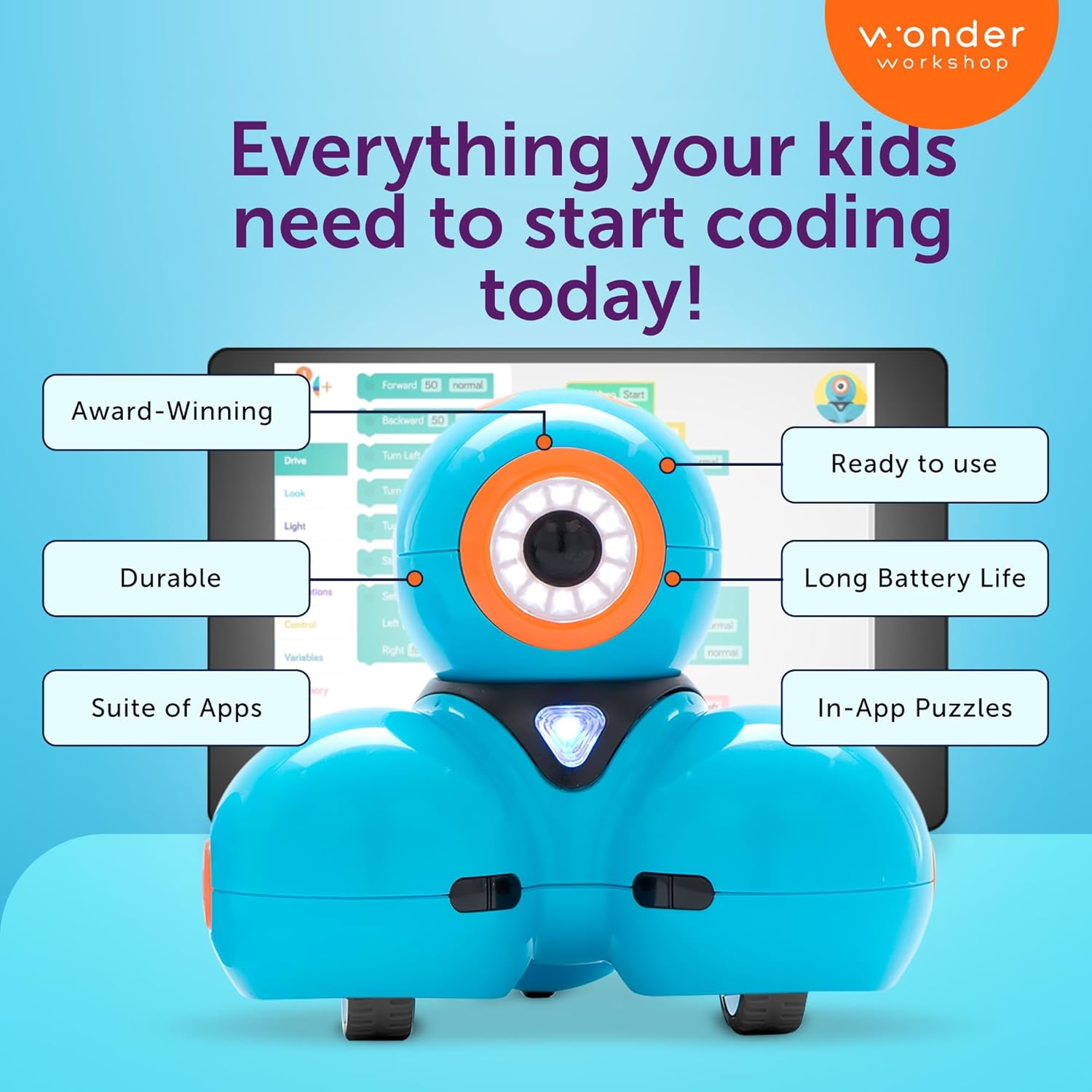
- Engaging and accessible for children aged 6+.
- Multiple intuitive apps cater to different learning styles and stages.
- Robust and durable construction, built to withstand enthusiastic play.
- Expressive personality with lights, sounds, and movements.
- Excellent battery life (up to 5 hours of active play).
- Rich ecosystem of accessories and curriculum available.
Cons:
- Premium price point may be a barrier for some.
- Requires a compatible tablet or smartphone to operate.
- The most advanced coding is still block-based, with less direct transition to text-based languages than some competitors.
- Can feel a bit large for very small hands or tight spaces.
Price: £169.99 (RRP)
Video Review
👉 Interested? Check the latest price for the Wonder Workshop Dash on Amazon UK
Currently available on Wonder Workshop Dash — Amazon UK. Prices may vary.
Design: A Robot with Personality
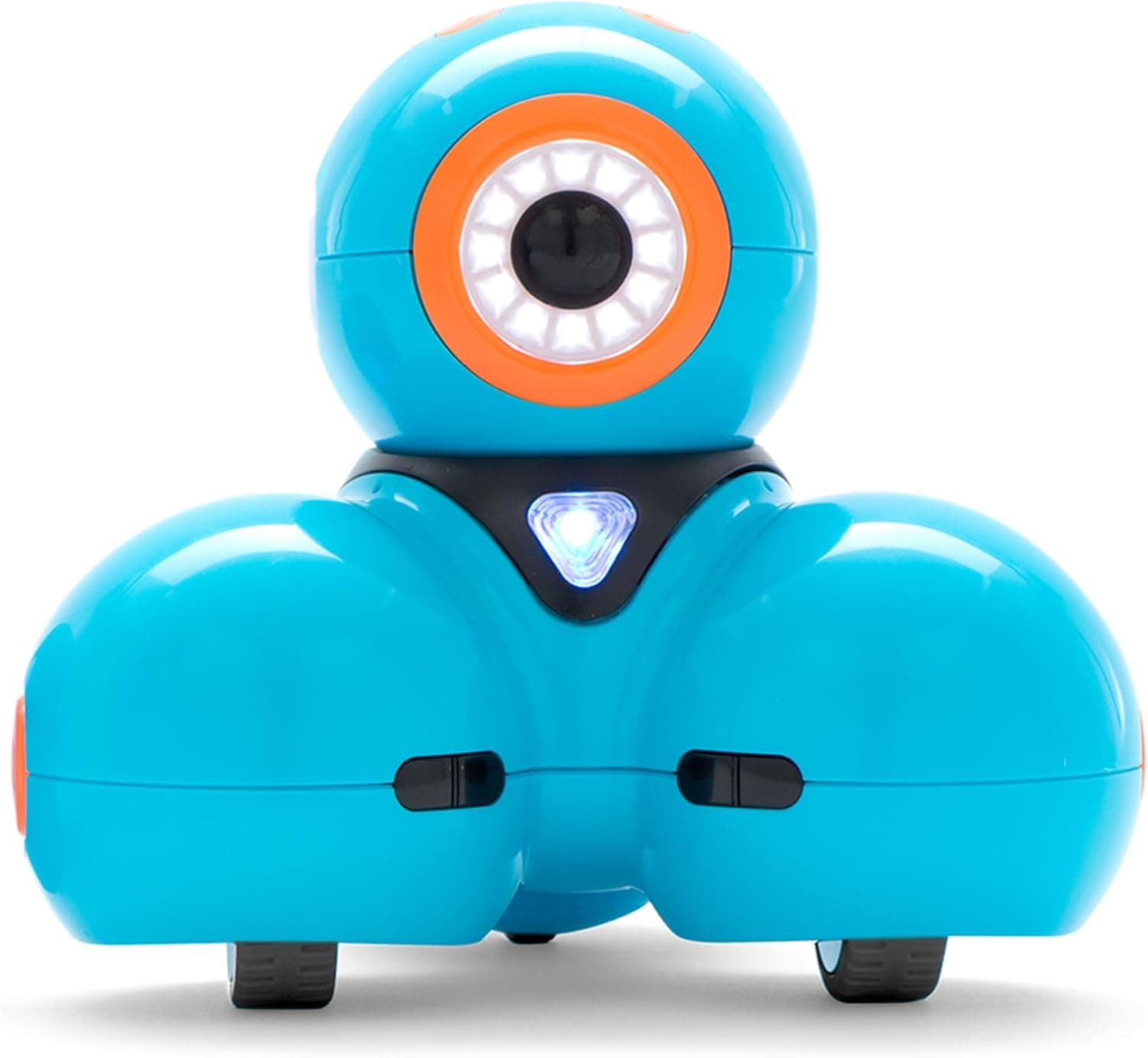
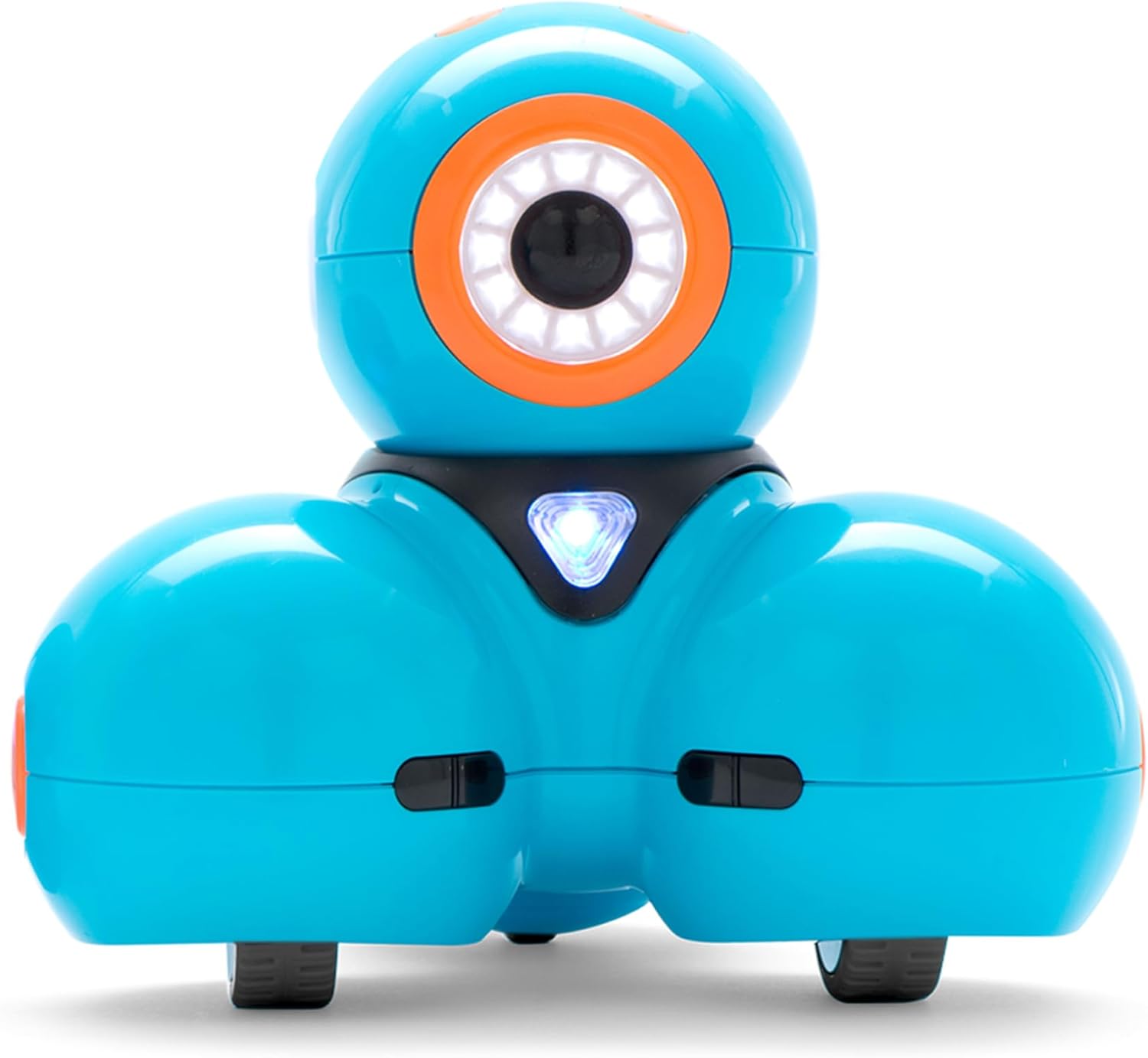
From the moment children meet Dash, they tend to be instantly drawn in by its friendly, almost anthropomorphic design. Unlike the sleek, abstract forms of some coding robots, Dash has a distinct head, three wheels for agile movement, and an array of expressive lights that give it a genuine sense of personality. Its bright blue colouring and smooth, rounded edges make it inviting and safe, removing any intimidation factor often associated with robotics.
Standing approximately 17cm tall and weighing around 700g, Dash feels substantial and well-made. The plastic casing is robust and designed to withstand the inevitable bumps and tumbles that come with active child's play, which is a major relief for parents. The three wheels provide excellent manoeuvrability, allowing Dash to move forward, backward, turn, and even spin in place with surprising grace.
Dash's expressiveness is a key design element. Its single glowing 'eye' (a multicolour LED light) can change colours and blink, conveying different 'emotions' or states. There are also smaller 'ears' that light up, and two large, round sound sensors on its head that resemble, well, ears! This thoughtful design ensures that children perceive Dash not just as a machine, but as a character they can interact with emotionally. The robot also emits a range of fun, futuristic sounds and phrases, further enhancing its persona and making the coding experience more immersive. The speaker is clear and audible, adding another layer to the interactive play.
The connectivity and charging are straightforward. Dash charges via a micro-USB port located discreetly at the back of its head. While not as seamless as inductive charging, it's a common and practical solution. The placement of the port also means no unsightly cables are dangling during play. Overall, the design successfully balances durability, functionality, and a captivating aesthetic, making Dash a visually appealing and approachable entry into the world of robotics.
Features: A Rich Ecosystem of Play and Learning
The Wonder Workshop Dash robot isn't a standalone toy; it's the central figure in a rich ecosystem of apps and accessories designed to make coding accessible and fun. This multi-pronged approach ensures that children can grow with Dash, continually finding new challenges and ways to interact.
Intuitive App-Based Control and Coding
Dash is controlled and programmed through a suite of free, intuitive apps, each tailored to different learning objectives and age groups:
- Go: This is the starting point for younger users and those new to Dash. The Go app acts as a remote control, allowing children to drive Dash, make it move its head, and trigger various sounds and lights. It's a fantastic way to familiarise themselves with Dash's capabilities and understand basic cause and effect.
- Path: In the Path app, children draw lines on the screen, and Dash follows them. As Dash moves along the drawn path, the app introduces simple coding concepts by allowing users to add actions (like playing a sound or changing eye colour) at specific points on the path. This visual, sequential programming is highly intuitive.
- Wonder: This is the core block-based visual programming environment. Wonder allows children to create complex sequences of commands using a drag-and-drop interface, similar to Scratch. They can program Dash to navigate mazes, react to sounds, detect obstacles, and even interact with its accessories. This app fosters computational thinking, problem-solving, and algorithmic design through creative projects.
- Blockly: Designed for slightly older children or those ready for more advanced block-based coding, Blockly introduces a more structured, logical coding environment. It's akin to the block-based coding found in many educational platforms and allows for more intricate programs and challenges. It lays strong foundations for understanding programming flow and syntax without diving into text-based code.
Sensors and Interaction: Responsive Robot Play
Dash isn't just a puppet; it can respond to its environment, making every interaction dynamic:
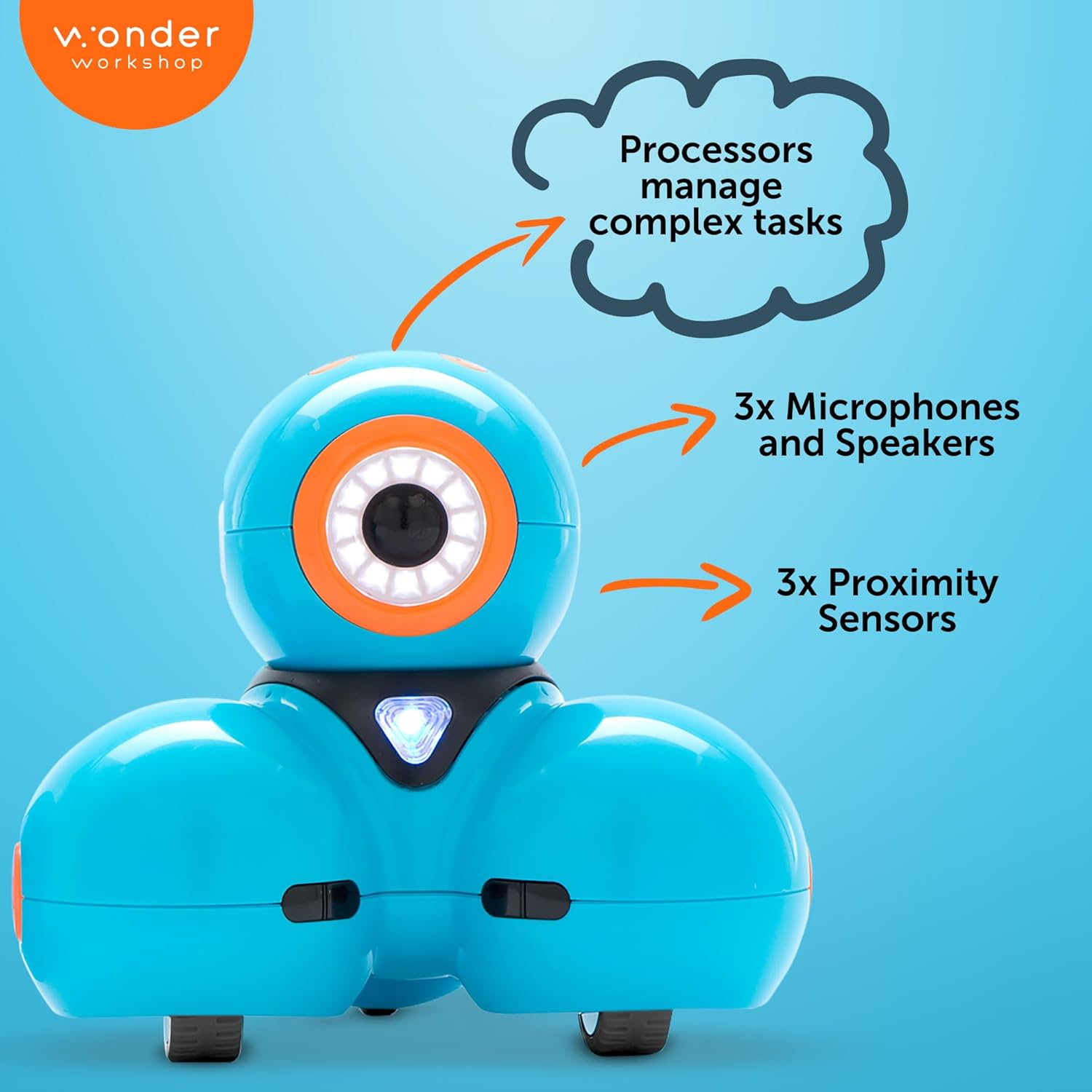
- Infrared Sensors: Located on the front of the robot, these sensors allow Dash to detect obstacles and avoid collisions. This is crucial for programming autonomous navigation and creates opportunities for engaging challenges like maze navigation.
- Microphones (Sound Sensors): Dash has two microphones that can detect sounds. Children can program Dash to react to claps, voices, or other noises, adding an auditory layer to their coding projects. Imagine programming Dash to dance when it hears music or respond when you call its name.
- Head Tilt and Pan: Dash's head can tilt up and down and pan left and right, adding to its expressiveness and allowing for more complex programmed movements and interactions.
- Programmable Lights and Sounds: As mentioned in the design section, Dash's LED 'eye' and 'ears' are fully programmable, as is its built-in speaker. Children can customise Dash's responses with a vast array of colours, patterns, and sounds, making each project unique.
Expandability with Accessories
Wonder Workshop offers a range of accessories (sold separately) that significantly expand Dash's functionality and play possibilities:
- Xylophone: Allows Dash to play musical tunes, blending coding with music education.
- Launcher: Turns Dash into a projectile-firing robot, adding an exciting dimension to play.
- Building Brick Connectors: These allow children to attach LEGO bricks (and other compatible systems) to Dash, integrating construction play with robotics and coding, fostering even more creative building and problem-solving.
This holistic approach ensures that Dash remains engaging and educational, constantly offering new avenues for discovery.
Age Appropriateness: Starting Early, Learning Effectively
Wonder Workshop positions Dash prominently as a coding robot for children aged 6 and up, and our experience confirms this is an ideal starting point. The robot's engaging personality and the app ecosystem's gentle learning curve make it highly accessible for this age group.
For 5 and 6-year-olds, the 'Go' and 'Path' apps are perfect introductory tools. They offer immediate gratification by allowing children to control Dash's movements and simple actions with ease. This visual, cause-and-effect learning helps them grasp the very basic concepts of sequential commands and robot control without needing to read complex instructions. Parental involvement at this stage is usually beneficial, acting as a guide rather than a commander, helping them to explore and understand what happens when they input certain commands.
As children move into the 7-9 age bracket, the 'Wonder' app becomes the true powerhouse. Here, they can dive into block-based coding, which introduces fundamental programming logic such as sequencing, loops, events, and conditionals. The visual nature of the blocks makes abstract concepts concrete, allowing children to build increasingly complex programs. This is where problem-solving skills truly blossom, as they devise strategies to make Dash complete challenges, navigate obstacles, and interact with accessories. The themed challenges within the app keep motivation high, making learning feel like an adventure.
For children aged 10 and above, 'Blockly' offers a more structured coding environment that builds upon the foundational skills learned in 'Wonder'. While still block-based, it prepares them for more advanced logical thinking, akin to what they might encounter in actual text-based programming. While Dash doesn't directly offer a transition to JavaScript like some competitors (e.g., Sphero BOLT), the skills acquired through Blockly are highly transferable to other graphical coding platforms and provide a solid conceptual framework for future studies in computer science. The availability of accessories like the Xylophone and Launcher also helps maintain engagement for older children by expanding play scenarios and creative projects.
In essence, Dash is expertly designed to scaffold learning. It caters to beginners with highly intuitive interfaces and gradually introduces more complex ideas, ensuring children aren't overwhelmed but are continuously challenged. It effectively bridges the gap between simple cause-and-effect play and foundational programming, setting children on a positive path toward STEM literacy.
Value for Money: A Solid Investment in Early STEM
At a price point of £169.99, the Wonder Workshop Dash robot represents a significant investment for a children's toy. However, when considering its educational depth, robust design, and consistent engagement, many parents will find it offers excellent value for money, particularly for fostering early STEM skills.
One of the primary arguments for Dash's value is its durability. It's built to last, capable of enduring rigorous play both indoors and outdoors. This longevity means that it won't be quickly broken or relegated to the back of the cupboard; it's a toy that can withstand years of active use by multiple children, potentially reducing its cost-per-play over time. The solid construction reassures parents that their investment is well-protected.
The real educational value comes from its comprehensive software ecosystem. The suite of apps (Go, Path, Wonder, Blockly) provides a carefully structured learning journey that genuinely adapts to a child's evolving capabilities. Unlike many toys that offer ephemeral amusement, Dash systematically teaches foundational coding concepts from sequencing and loops to events and conditional statements. These are not just abstract ideas; children see their code come to life through Dash's movements, sounds, and interactions, making learning tangible and exciting.
While the upfront cost is higher than some entry-level coding toys, the depth of content and the continuous challenges available through the apps and optional accessories (which do add to the overall cost) ensure that Dash retains its educational relevance for an extended period. It cultivates critical thinking, problem-solving, and creativity – skills that are invaluable in school and beyond. For parents keen to give their children a genuine head start in computational literacy and robotics, Dash provides a stimulating and effective platform. It’s an investment in a child’s intellectual development, wrapped in a playful, friendly robot.
Competitor Mentions: Where Dash Fits In
The landscape of educational robots is diverse, but the Wonder Workshop Dash holds a strong position, especially for younger coders. Let's see how it compares to some of its notable competitors.
Vs. Sphero BOLT: At a similar price point (£149.99), Sphero BOLT is another excellent coding robot. While Dash focuses on an anthropomorphic design and multiple apps tailored for younger learners, BOLT's spherical design and transparent casing highlight the internal mechanics and its 8x8 LED matrix is a visual marvel. BOLT also offers a direct pathway to JavaScript coding, appealing more to older children or those ready for text-based programming. Dash, however, is arguably more immediately engaging for younger children (6-8) due to its friendly appearance and highly visual app interfaces. BOLT offers deeper technical exploration, while Dash excels in approachable, personality-driven learning.
Vs. LEGO Boost Creative Toolbox: LEGO Boost (£129.99) is a fantastic option for children who love building and coding. It combines physical construction with block-based programming. Boost offers the unique advantage of tangible creativity in building different robot models, which Dash does not. However, Dash comes pre-assembled and offers immediate, varied play scenarios through its various apps and accessories without the need for initial construction. For children more drawn to pre-built, instantly interactive robots, Dash might be preferred, while Boost is ideal for those who enjoy the hands-on engineering aspect.
Vs. Cozmo 2.0: Cozmo (£229.99) from Digital Dream Labs is more of an AI personality robot with a focus on companionship and interactive play. While it includes some basic block coding, its primary appeal is its expressive emotions and ability to recognise faces and objects. Dash, conversely, is singularly focused on teaching coding and robotics fundamentals through structured challenges. If the goal is explicit coding education with tangible outcomes, Dash is the clearer choice; if the goal is a playful, emotional robot companion with some coding sprinkled in, then Cozmo excels.
Vs. Osmo Coding Starter Kit: Osmo Coding Starter Kit (£79.99) offers a unique physical-to-digital coding experience using tangible blocks that interact with an iPad camera. While innovative, Osmo's coding is primarily screen-based and game-oriented, and it lacks a physical robot that moves and interacts with the real world independently. Dash, as a physical robot, provides a more immersive and spatial coding experience, teaching children about movement, navigation, and environmental interaction in a three-dimensional space that Osmo cannot replicate.
In summary, Wonder Workshop Dash distinguishes itself by offering an incredibly approachable and personality-filled entry into the world of robotics and block-based coding, particularly for the 6-9 age range, with its robust design and comprehensive app suite being major selling points.
FAQ: Demystifying Your Dash Robot
Q1: What exactly can Dash do?
A: Dash can move forward, backward, turn, and spin. It can detect objects in front of it, respond to sounds (like claps), emit a variety of sounds and phrases, and its LED 'eye' and 'ears' can change colours and display patterns. Through its various apps, children can program these actions and reactions to create complex sequences.
Q2: Does Dash require an internet connection to work?
A: An internet connection is required to download the initial apps. Once the apps are downloaded, Dash can be controlled and programmed offline via Bluetooth, making it great for places without Wi-Fi, like car journeys or parks. However, app updates and access to online lesson plans would require internet.
Q3: Can Dash be connected to other building toys like LEGO?
A: Yes! Wonder Workshop offers Building Brick Connectors (sold separately) that allow you to attach LEGO bricks and other compatible building systems to Dash. This significantly expands the creative possibilities, letting children design and build custom contraptions on top of their robot.
Q4: How long does the battery last and how do I charge it?
A: Dash has an excellent battery life, offering up to 5 hours of active play on a single charge. It charges via a micro-USB cable (included) which plugs into a discreet port at the back of its head. A full charge typically takes about an hour.
Q5: Is Dash suitable for a classroom environment?
A: Absolutely. Dash robots are widely used in primary school classrooms and educational settings around the world. Wonder Workshop provides extensive curriculum resources and lesson plans specifically designed for educators, making Dash an ideal tool for teaching computational thinking and robotics in groups.
Final Verdict: Unleash the Future Coder
The Wonder Workshop Dash robot genuinely lives up to its promise as an engaging and effective tool for introducing children aged six and up to the exciting world of coding and robotics. Its charming design, complete with expressive lights and sounds, provides a level of personality that transforms it from a mere gadget into a lovable companion, making the learning journey feel like a delightful adventure.
What sets Dash apart is its meticulously designed app ecosystem. From the simple remote control of Go to the graphical block-based programming of Wonder and Blockly, it thoughtfully scaffolds the learning experience. Children are never overwhelmed but are continuously challenged, building confidence as they master progressively complex computational concepts. This tiered approach ensures the robot remains relevant and educational as a child's skills develop, moving far beyond fleeting novelty.
Beyond just teaching coding syntax, Dash fosters crucial 21st-century skills: critical thinking, logical reasoning, problem-solving, and creativity. Children learn to deconstruct challenges, strategise solutions, and debug their code, all while having immense fun. The robust construction is another significant plus, offering parents peace of mind that their £169.99 investment is durable enough to withstand years of enthusiastic play.
While it sits at a premium price point, the Wonder Workshop Dash delivers exceptional value through its longevity, educational depth, and capacity to inspire a genuine passion for STEM. For UK parents looking for a tangible, interactive, and deeply engaging way to ignite their child's curiosity in technology and prepare them for a future driven by innovation, Dash is an outstanding choice. It truly makes learning to code an unforgettable experience, paving the way for future inventors and innovators.